Running the Race and Finishing Well

Peninsula Community Church
Running the Christian Race
December 30, 2012

As we come to the end of another year, I have spent the last couple of days looking back at this year and all that has been accomplished. I have also spent these days in thinking about my goals and desires for 2013.

As I look back at this year, I realize that we can rejoice in so many accomplishments that have been achieved here at PCC. I look at people’s lives that have been touched and blessed this year. I thought about the ministries we have and how they have reached so many people for Christ. I thought about this year’s VBS where kids from around the community joined us for a week of fun and biblical focus. I thought about how the VBS participants were able to bless Renee Bach and Serving His Children with a check for $1500. I look back at the Harvest Party where we had approximately 250 people visit the church for free hotdogs, sodas, chips and desert as well as fun games and bounce houses. I thought of the parade where we won first place in the noncommercial float category but more than that we had a presence in the community and had many ask questions about the float which led to sharing our faith with others.

I thought about Clayton sharing the Gideon’s message and the nearly $2000 we received in the offering which was one of the largest offerings given by a church in the DelMarVA region in several years. I also thought about the news I received that the offering we gave helped the Gideon Ministry in distributing nearly 4000 bibles to Salisbury University, the FCA ministry and the prison at Georgetown at the end of November and early December. I thought about the Christmas program where more that 75% of those attending the event were unchurched or did not have a church home. I looked back at the beginning of 2012 where we were healthy financially, but our cash flow presented issues for us. I am pleased to announce that we now have more than 3 months worth of finances on hand plus another $40,000 in stocks and the anticipation of another large donation coming to us at the beginning of this new year.

While all of this is important, I also thought of the people who have been touched by PCC and God this year. I thought of Penny and her family who lost everything in a fire and yet the church stepped up to donate money, clothing, furniture, and food. I thought of Gerry Wingate who has seen the touch of God on his life and has had years added to his life because a doctor was willing to do one more test. Instead of 29% heart usage they found that he was in reality at 39%, which is huge in relationship to his longevity. I thought of Baby Carter who has survived multiple surgeries before he is three months old and now he is home and growing like a weed. I thought of many others that have been going through difficult times but they have seen God minister grace to them. I thought of Jim Koons, Arlene Marvel, Phillip Dypsky, Sandy Brooks, Bob Zabit and others who have been battling physical issues but sense the presence of God in their lives in new ways. I thought of Michelle whose doctor believes her MS is in remission and therefore does not have to take her weekly medication which caused her to miss a day of her life because of the drastic side effects. I thought of so many who have come to PCC who once thought they would never attend another church because of the failures of pastors and the leadership of their previous churches.

We have so much to be thankful for. We are a blessed church. While He has done so much for us we are standing on the threshold of a new year which means we can look forward to new and exciting things that God will do in and through us. I do not know what is in store for us but I know that He will be with us and He will do great things in us. While we look back at the exciting things that have occurred this past year, we cannot live in the past but we must move forward into the future with hope and faith.

Paul understood this when he penned the words found in Philippians 3:12-15. He proclaimed, Brothers, I do not consider that I have made it my own. But, one thing I do: forgetting what lies behind and straining forward to what lies ahead, I press on toward the goal for the prize of the upward call of God in Christ Jesus. Let those of us who are mature think this way, and if in anything you think otherwise, God will reveal that also.

In Philippians 3:3-7, Paul states that he had so much to brag about and so much that he could hang his hat on but he counted all of those successes as rubbish compared to what fellowship with Christ meant to him. His heritage, his accomplishments, and his friendships were not as critical to him as his ongoing need to understand Christ. He also understood that his past successes were just that, past successes. He could not live on the laurels of the past but always needed new adventures and growth in Christ.

In the passage before us today, Paul uses the analogy of an athlete and specifically a runner. Throughout my life, I have always admired marathoners and long distance runners. They have a stamina and patience that is amazing. Almost every day they are running so that they can build their strength and their ability to run the entire race. It was amazing to me to learn that most people who participate in marathons do so not to win the race but to simply finish. In essence, they win when they finish the race. For most marathoners, their competition is not just the other runners but the greatest competition is often within themselves.

I am not sure that you know this but we have a 5ker here at PCC, Trina Coyle. She has already completed a couple of races. I would like to invite her up here for a moment so that I can ask her a couple of questions.
Why did you decide to run a 5k?
How many hours a week do you run?
How often do you increase the distance you run?
How many miles do you run at this stage?
Why do you enter a marathon? Is it to win? Is it the satisfaction of finishing the race?
How often do you feel like giving up? What motivates you to keep going?
When you are running a race, are there times that you look back? Why would you do that? Why is it important to keep your eyes on the road ahead of you?

Thank you Trina. As we think about running a race, there are several lessons for us to consider.

The first of these is you can’t finish a race you have not entered. God is calling us to get into the race. He alludes to the idea of racing in a number of passages of scripture. The problem is that there has never been a race won from the sidelines. God is calling us to get into the race so that when our lives are over we can echo the words Paul wrote to Timothy. I have fought the good fight, I have finished the race, I have kept the faith. Henceforth there is laid up for me the crown of righteousness, which the Lord, the righteous judge, will award to me on that Day, and not only to me but also to all who have loved his appearing (2 Timothy 4:6-8).

We enter the race when we accept Christ as our personal Savior, but even after accepting Christ as our Savior we can still sit back and watch others run the race. When this happens, we can be bored and never get to experience the success of running the race. You have to be in the race to enjoy the benefits of preparing for the race.

The second lesson is a marathoner’s attitude is critical to finishing a race. Runners have an attitude that is focused and they are determined. They remain focused on the finish line. You do not find a runner focusing on what is behind them as this will distract them from the goal of finishing the race. As a runner, you must watch for pot holds, the other runners, the inclines and bends in the road. If you don’t, you will be susceptible to failure and less than desirable outcomes. Paul again gives us some insight into the life of a runner when he says, every athlete exercises self-control in all things. They do it to receive a perishable wreath, but we an imperishable. So I do not run aimlessly; I do not box as one beating the air. But I discipline my body and keep it under control, lest preaching to others I myself should be disqualified (1 Corinthians 9:24-27). Paul is saying that when we run this race we do not run without a goal in mind. We do not run in circles but we always have the goal in mind.

The third lesson is runners always put the time in that is required to prepare to finish the race. Pure marathoners don’t just jog for exercise; they’re into it all the way. They read magazines about running; they set goals for themselves; they train and push themselves toward those goals. They watch their diet. None of these things are easy in themselves but they are important. We too have the necessary tools to finish the race. We have the Bible which gives us His plan. We can pray to seek His advice. We can memorize Scripture that will encourage us and challenge us. We can increase our fellowship with other believers who will encourage us in our growth. To win the spiritual race we must implement the tools available to us or else we will fall short of the goal of finishing the race. We must also lay aside the weights and the sin that cause us to not finish the race. Therefore, since we are surrounded by so great a cloud of witnesses, let us also lay aside every weight, and sin which clings so closely, and let us run with endurance the race that is set before us, looking to Jesus, the founder and perfecter of our faith, who for the joy that was set before him endured the cross, despising the shame, and is seated at the right hand of the throne of God (Hebrews 12:1-2).

If you are not in the race are you ready to join? Are you ready to do what it takes to finish the race? It is your choice. As you make the choice, God will give you the strength you need.

Leave a comment

Filed under Uncategorized

God’s Gift of Family – From Humiliation to Exaltation

Peninsula Community Church

December 23, 2012

God’s Gift of Family – From Humiliation to Exaltation


Text: Matthew 1:1-6 & Matthew 1:18-25 

Now the birth of Jesus Christ took place in this way. When his mother Mary had been betrothed to Joseph, before they came together she was found to be with child from the Holy Spirit. And her husband Joseph, being a just man and unwilling to put her to shame, resolved to divorce her quietly. But as he considered these things, behold, an angel of the Lord appeared to him in a dream, saying, “Joseph, son of David, do not fear to take Mary as your wife, for that which is conceived in her is from the Holy Spirit. She will bear a son, and you shall call his name Jesus, for he will save his people from their sins.” All this took place to fulfill what the Lord had spoken by the prophet: “Behold, the virgin shall conceive and bear a son, and they shall call his name Immanuel” (which means, God with us). When Joseph woke from sleep, he did as the angel of the Lord commanded him: he took his wife, but knew her not until she had given birth to a son. And he called his name Jesus. 

As we come to the close of this series, today, we are looking at the story of Mary and Joseph. Through this story, we are confronted with the amazement of God’s grace. As we peer into the lives of Mary and Joseph and the conditions that had an impact on the news they were about to receive, we see a couple that move from a position of humiliation and potential embarrassment to a position of exaltation.  

As we look at this passage, there are few things that stand out to me. First, we find that Mary and Joseph were betrothed to one another. When we hear the term ,”betrothal” it does not hold much meaning to us. My guess is that we only hear this term when we read the story of Christ’s birth, but the term in Biblical days had great meaning. The term “betroth” or “betrothal” αρμοζο (harmozo) is a term that literally means to “pay the price to gain the right of possession.” The groom would ask the father of the potential bride for his daughter’s hand in marriage but to secure the proposal he was to pay a predetermined price to the father for his future bride. The price to be paid was based on both the groom’s and the bride-to-be’s status socially and economically. For example, if the groom’s family were poor the price paid might be in livestock. If the family was more wealthy, the price would be much higher and could, in fact, be several thousand dollars and possible property.

Once completed, the transaction attached the woman to the man as if they were married. It was an interesting transaction as it was often a period of ten to twelve months before they would be officially married. It should be noted that during this betrothal period that there was to be no physical contact whatsoever. While there was certainly social contact during this period, physical contact was strictly forbidden. Once initiated, the act of betrothal was legally binding and could only be broken in cases of adultery. Therefore, the breaking of a betrothal covenant required a bill of divorce and was therefore a serious transgression. When this happened the woman accused of adultery faced death by stoning if the groom or the groom’s family were to insist on this action.

It is for this reason, when Joseph heard the news of Mary’s pregnancy, he assumed the worst. His first assumption was that Mary had committed an act of adultery and had therefore nullified the betrothal covenant. Can you imagine the emotions that he initially experienced? I am sure that he felt betrayed and used. I am sure there were concerns about what people would say. It is easy for us at this point to say that it was no big deal because we see the end of the story. We must remember at the time he did not know what the future would hold. Even with these emotions, we find that he was a righteous man and instead of taking the legalistic approach to the law which called for stoning, he choose instead to exhibit a spirit of grace. Rather than see her humiliated and worst case stoned, he made plans to divorce her quietly and respectfully. 

In the height of his despair, Joseph had a dream where the angel of the Lord came to him. He spoke to Joseph’s heart and proclaimed that he should not fear and that this event was beyond any one human’s doings and therefore would see a different outcome. This was a work of almighty God himself. He, God, had impregnated Mary through the work of the Holy Spirit. This was God’s child and Mary was to be the channel by which the Messiah would come. He would be all God and He would be all man wrapped in human flesh. He would be called “Jesus,” the Savior of the world. As we see in the account of Luke, He was to be called “Immanuel” which means “God with us.” In other words, He would not be a distant God where man could not reach Him but He came low so that all men might have total and complete access to Him. He came to earth so that He could experience life as a man. He was totally human, but He remained righteous in all of His ways and did not sin.

Unfortunately, as we review this story, we are only touching the surface of all that is contained here. Time does not allow us to dig as deep as we could, but I would encourage you to do your own study to mine the gems hidden in this story.  

As we have noted in our previous studies, I believe we can learn some great lessons from this story. The first lesson I see if that nothing is impossible with God. While it was impossible to be pregnant without having sex, it was not impossible with God. He is the creator and sustainer of all life. He needed a channel for His son’s birth. He needed a human vessel that would give birth to His son. This was not some sensual act on God’s part but in essence, Mary became the surrogate for God’s son so that He would remain fully God. He also needed a human mother so that He could experience life not as deity but as a human. So, Mary was given this most holy responsibility. As we read scripture, we now know that in the City of David the Christ was born to humble and yet righteous parents who were favored and chosen by God for a greater purpose. What could have been a humiliating situation turned into an exaltation of Mary and Joseph.

The second lesson we see is that God reaches out to people and includes them in His family even though we might not have included them ourselves. He has included the Judah and Tamar’s of the world. He has included the Rahabs of the world. He has included the Boaz’s and Ruth’s of the world. He has included the David and Bathsheba’s of the world. Now, we see that he also includes the Mary and Joseph’s of the world. Each of these stories teach us that Christ came to change our dysfunctions into breakthrough, our barrenness into fullness, our failures into forgiveness and now we see that God takes our humiliation and turns it into glory and exaltation. Mary and Joseph upon hearing the news was humiliated and wrought with wonder about how such a thing could occur, but we see that as they accepted the path that God had chosen them to take, they found favor with God. Why? It was because they were in the center of His will. The fact is in life we may not always understand the journey we are on, but we can be assured that God knows where you are and He will provide a way of escape so that His is glorified and so that you will find your destiny in Him.

The third lesson we see is that Christ has come to betroth himself to us. He wants to be our groom and we His bride. He wants us to live like we are married to Him. There will come a day when He will come to us as that bridegroom to take us from our earthly home to the home that has been promised to us. In the meantime, He has paid the betrothal price by giving Himself for our sin. He gave us His life so that we could be forgiven of all of our sin. We get to enjoy His presence, but one day He will come and gather His bride to Himself. That bride is the church. This is not the visible church but the true church that has accepted the price paid. What a price he has paid? He bought us from the marketplace of sin and has called us to Himself. He paid the price to gain possession of us or in reality He repossessed us.

How about you?  Do you know that you are His? Have you accepted the price He paid? It is free and available to all who will receive this gift. He has come and we have been called to be His bride.


Leave a comment

Filed under Uncategorized

David – From Failure to Forgiveness

Peninsula Community Church

December 16, 2012

God’s Gift of Family – From Failure to Forgiveness

Text: Matthew 1:1- and 2 Samuel 11:1-12:25

As we continue to focus our attention on the family of Christ, our discussion this week will center on the story of David and Bathsheba. As we read this story, one of the first things that stands out to me is that David rather than being with his army, is at home. Listen to what the scripture says here. “In the spring of the year, the time when kings go out to battle, David sent Joab, and his servants with him, and all of Israel.” It was common in those days for the king’s armies to take a break from battle in the winter as it was difficult to fight during the colder months. But once spring came, the kings returned to battle. It was important for the king to lead his armies but notice that David stayed in Jerusalem.

As we read through this text, we witness a process of sin that causes a downward spiral toward disobedience on a grand scale. Notice how the process is involved in this story. The process is simply this he saw, he coveted, he took, and he hid and covered up his sin. These four elements are almost always involved in the cycle of sin and disobedience. Let’s see how these are played out in David’s life.

First of all, we see that he saw. Because David stayed at home and was idle instead of being where he should have been he is presented with a moment of decision. As he is walking on his on his roof top, he sees a beautiful woman bathing on the rooftop of her home. In this moment, he has a choice. He could either turn away, reject the temptation that was brewing in his heart or he could continue to stand there and continue to stare at the one bathing. It is unfortunate that he chose the latter, as this was the beginning of him sliding into a state of extreme failure. Instead of taking on the attitude of Joseph when he was presented with an opportunity to sin we find that David lusted for Bathsheba.

Because of his lust for her, he coveted her. It is of great import to note that David inquired about who she was and yet even though those around him told him that she was a married woman, he continued to pursue her. It is interesting to note that he could have stopped his slide toward failure right here but he takes the next step.

It is here that David takes the next step toward his catastrophic failure. He saw, he coveted and he took her. David summons Bathsheba. He calls for her to come to his palace. As the king, he could summon anyone he wanted and almost do anything that he wanted to do. But notice that there seems to be no push back from Bathsheba. She could have refused but we don’t see that she made any effort to reject his advances. Either one of them could have cut this off but he took her and had an adulterous affair with her. He chose to commit a great sin even though he already had in his possession anything that he wanted. But he chose to go after one that could not have.

Now the story gets interesting as we find that she sends word to David that she is pregnant and that the child is his. After the consequences of his sin were revealed, instead of repenting, we find that he tries to hide his sin. He invites Uriah home in hopes that he will lay with his wife and think that the child she is carrying is his. When that doesn’t work he tries to get him drunk but even in a drunken stupor he refuses to go to his wife. It is notable to observe that it seemed that he was more loyal to the army and his comrades than David, the King was. When all the above fails David sends him to the front lines with orders given to Joab that he should be placed on the battle lines where he was sure to be killed. In essence, he was being setup. In reality it is murder. Notice that in 1:27 “The thing that David did displeased the Lord!”

But rather than seek forgiveness and do the right thing it seems that David became comfortable with his sin. You see it would have been nice for David to recognize his sin and deal with it and a year passed and David has not confessed or repented of his sin. But God sent Nathan into David’s life. Nathan tells David a story by way of a word picture and then seeks his advice about what should be done to the one who committed a serious wrong. Nathan’s story was one of a rich man who had many sheep and a poor man who had only one. When the rich man had quests arrive, he took the poor man’s lamb and had it killed so that he could feed his guests. Nathan Asks David what he would do. David is angered about this and he stated that this man deserves to die and he should restore the loss four fold.

Then Nathan makes a statement that reaches a level of crescendo in David’s heart and mind. “David, you are the man.” What sad words. But these words penetrate David’s heart and he immediately repents. It should be noted that it is from this experience that we find that David pens the words of Psalms 51, 32 and 36. David experiences God’s forgiveness but his actions come with a price.

As a result of his sin that went without a righteous confession, David had to suffer a great price. Notice that Nathan proclaims the results of his sin. Because David kept this a secret, his punishment was to be in administered in the open. And, it impacted more than just him. The sin committed by David and Bathsheba would result in the death of the child conceived between David and Bathsheba …Nathan continues by saying – Now therefore the sword shall never depart from your house, because you have despised me and have taken the wife of Uriah the Hittite to be your wife.’ Thus says the LORD, ‘Behold, I will raise up evil against you out of your own house. And I will take your wives before your eyes and give them to your neighbor, and he shall lie with your wives in the sight of this sun. For you did it secretly, but I will do this thing before all Israel and before the sun'” (2 Samuel 12:10-12).

In the end David and Bathsheba have a second child together and his name is Solomon. Christ’s lineage would be kept in tact even though there was a grievous sin and difficult consequences involved.

As we look at this story we see that there are several lessons to be learned. First of all when we find that we are spending more time trying to hide our sin than deal with it we have a problem. Isn’t it interesting that David spends such an inordinate amount of time trying to hide his sin rather than making his sin right.

Secondly, we note that sin has consequences. We see that his sin caused the loss of his son. There will also be great turmoil as the sword would not depart from his kingdom. God also brings about evil in his home. And finally we see that his wives will be taken and given to his neighbors. We see this worked out in a number of ways. For example, the current headlines of this young man that perpetuated these actions on this elementary school has now caused there to be a ripple effect around the world. For many there has been the act of adultery in their lives and though they thought they had the act revealed, the ripple effects of those actions are felt by the family, the spouse, the children, and by their associates.

Thirdly, we all need a Nathan in our lives. We need someone that will speak the truth and bring us to the place of recognizing of the reality of our hearts. It should be noted here that we must be sure that God has called us to be a Nathan in someone else’s life. Too often we get involved when it was never God’s will.

Fourthly, there is always forgiveness in Christ. There is never a sin too great, too bad, or too evil that God cannot forgive. There is forgiveness at the foot of the cross. Forgiveness and repentance is not to be something that is feared but rather it is to be embraced as it brings freedom to the heart. Regardless of the consequences of our decisions we can live with a heart that is free. We can walk in liberty. Once again notice the power of these words in 2 Samuel 12:13, “The Lord has put away your sin; you shall not die.” He is forgiven and he is restored.

Leave a comment

Filed under Uncategorized

From Barrenness to Fullness

Peninsula Community Church
December 9, 2012
God’s Gift of Family – From Barrenness to Fullness

Text: Matthew 1:1-6 and The Book of Ruth

I have made a decision this morning to skip the story of Rahab and move to the story of Ruth. This is not meant to diminish the value of Rahab’s story but I feel that it is important to go to Ruth’s story as it stands in dark contrast to Judah’s and Tamar’s story (Gen. 38). Last week, we saw a story of deceit, deception and broken promises. This week, our story begins in a similar way but has a different outcome and a different tone to it in many ways.

Our story today takes place in the days of the judges who ruled the land (1:1). If you remember your biblical history this was a time when the people would follow God for a season and then they would turn their backs on God and do their own thing. Each time, God would raise a judge up to bring order and to save the people. While it is not clear when this story took place precisely, most historians believe it occurred about the same time as Samson (Judges 13-16).

In studying this story, we could divide the story into two sections. One section would be the story of barrenness and the second section would be the story of fullness and fulfillment.

We begin with barrenness in the land as there was a famine in Bethlehem (1:1). As we read this story we see instances of great irony. The first bit of irony is in the fact that the term Bethlehem means “city of bread” but the “city of bread” was barren and no crops were being produced. Because of the famine and the barrenness of the land, Elimelech decided to move his family to Moab where it seemed that the land was prosperous. This action, however, showed a disregard for the provision of God. It is interesting to note that Elimelech’s name means “God is Sovereign” or “God is King.” Instead of trusting God which Elimelech’s name intimates, he chose rather to take things into his own hands and relocate his family to a land that would present some great challenges.

By moving to Moab, Elimelech put his family at risk because the Moabites manifested a total disregard for God’s ways. The Moabites were especially known for sacrificing children to appease their gods. By moving to Moab, Elimelech was exposing his family to these ungodly religions and unholy acts. He also diminished the possibility that his sons Mahlon and Chilion would marry godly women.

As the story progresses, we see that there the barrenness in relationships. As life would have it we find that Elimelech, Naomi’s husband, dies. We do not know why he died. Some theologians have tried to intimate that he died as a result of his disobedience in moving away to a land where he and his family would be influenced by ungodly men and women and their ways. But there is no clear indication in the text as to this conjecture.

Prior to his death he and Naomi, his wife, had two sons. They were named Mahlon and Chilion. It is ironic that Mahlon’s name meant “sickly” or “diseased” and Chilion’s name meant “weakness” or “wasting away.” Names were important then but even these names baffle the mind as to why these parents would have named their children such names. Mahlon and Chilion married two Moabite women named Orpah and Ruth. But after ten years these men died and Orpah and Ruth found themselves facing the rest of their lives as widows. And if you remember our discussion from last week, you will remember that that this is the last place a woman would want to find herself: husbandless and without much hope for the future. And because Noami did not have any other sons, there was little hope for the future for any of them.

Because of these deaths, Naomi and Elimelech’s family is now facing the barrenness of heritage. Because of the death of her husband, the death of her two sons and the lack of sons to carry on the family name, we see that Naomi fell into a deep depression. It is interesting to note that her name meant “my pleasantness” or “sweetness.” But after the death of her husband and her sons she proclaimed that her name would no longer be Naomi, “sweetness” but would be Mara “one who is bitter.” No one could blame her as she was left without a husband, no son to care for her, and no heritage to depend on. As far as she was concerned life was over. She was all alone. In her despair, she encouraged her daughter-in-laws to return to their respective families but an interesting thing happens.

Orpah whose name means “turning back” decided to return to her home. In the text, we witness the act of Orpah kissing her mother-in-law which was a way of Orpah saying goodbye (1:14). She would take her chances with her family. Ruth on the other hand clung to Naomi. For the record her name means “a friend.” A true friend is one that is with us no matter what happens or what issues arise. Ruth was that kind of friend. Ruth had a spiritual awakening as her cry was “Your people will be my people and your God will be my God.” It is supposed by some that Naomi had an influence on her life to the degree that she had accepted the ways of Jehovah and had committed her heart to God.

So off to Bethlehem they go and once they arrive back in Bethlehem, things begin to change. There is a glimpse of hope and life. We now turn from barrenness to fullness. Let me share with you where I see fullness manifested.

There is fullness in that Ruth finds favor with Boaz. Naomi remembers that Elimelech had a relative named Boaz that could help them. Noami instructs Ruth to go and glean from his fields. The law of the land was that the homeless and poor could go onto the fields after the harvest and collect whatever grain had fallen to the ground. As the story progresses, we see that a love story begins to blossom. Boaz takes notice of Ruth and he offers her shade and protection. He instructs those harvesting the grain to leave extra behind for her so that both Ruth and Naomi will be cared for. In Ruth he saw a woman committed to caring for Naomi and a woman that was humble and pure.

There is fullness in God’s provision of a kinsman redeemer. Boaz had the potential of being Ruth’s kinsman redeemer according to the Levirate law (4:1-13). But there was an obstacle in the way. There is one other that would precede Boaz, so Boaz goes to him and offers a deal. It is interesting to note that when the next of kin thought he was going to inherit land and money he was excited but when he realized that the deal also included marrying a Moabite he decided that he did not want to do this because it would cause all that he had to go to Elimelich’s family. He was more concerned about his name and his heritage than he was helping out Ruth and his relative Elimelech.

When the kinsman refused Ruth, a common ritual for that day was performed. The custom of the day was that when the kinsman redeemer gave up his right he would remove his sandal and give it to the next heir. The sandal represented the land that was to be possessed as when someone drew up a contract for land it was measured by one stepping off the land that was to be apportioned. In some cases when the next of kin would refuse the widow, they would take the sandal and would spit on the ground as a means to humiliate the one refusing to follow through with their commitment. Some historians believed that sometimes the widow would spit in the face of the offender. Boaz through his actions confirmed to the elders that he had bought Elimelech’s inheritance so that the name of the dead might not be cut off from his brothers and the gates of the native place.

From here we see that Boaz and Ruth are married.

Fullness in God’s provision of a future and a hope. What began as barrenness we now see as fullness because God provides a son for Ruth and a heritage for Naomi and Elimelech’s name would be remembered. Ruth gives birth to Obed. But notice what transpires. The people are not as excited for Ruth as they are for Naomi who now has a grandson and an heir.

Listen to what the Bible says here in Ruth 4:14-17. Then the women said to Naomi, “Blessed be the LORD, who has not left you this day without a redeemer, and may his name be renowned in Israel! He shall be to you a restorer of life and a nourisher of your old age, for your daughter-in-law who loves you, who is more to you than seven sons, has given birth to him.” Then Naomi took the child and laid him on her lap and became his nurse. And the women of the neighborhood gave him a name, saying, “A son has been born to Naomi.” They named him Obed. He was the father of Jesse, the father of David.

While Naomi has an heir this is no ordinary heir for Obed ties the genealogy of Perez to David and in essence ties Perez, Obed, and David to Christ himself. What a glorious day!

So what do we learn from this?

First, we learn that God is at work in the darkest moments of our lives. When we don’t see Him working, He is often working the hardest for us.

Secondly, we see that out of barrenness comes life. When we think that all is lost, God intervenes and brings life. And, sometimes it is in very interesting ways.

Thirdly, we can miss the blessing of God even when there is blessing all around us. While her husband and sons had died, Naomi missed out on the fact that she had a daughter-in-law that loved her and would do anything for her.

And finally, we must realize that Jesus came as that elder brother who would become our kinsman redeemer. He is the one who would give himself for us so that we would have an inheritance, a hope and future.

Leave a comment

Filed under Uncategorized

God’s Gift of Family – Dysfunction to Breakthrough

Peninsula Community Church

December 2, 2012

God’s Gift of Family – Dysfunctional to Break Through

 As we continue our this series this morning, I am reminded of what Tim Keller, the senior pastor of Redeemer Presbyterian Church in New York City had to say about this particular story and stories like it in the Bible. He stated that “we can’t always read the Bible as inspirational stories for us to imitate.” The reason for this is that some stories serve to warn us about the consequences of broken promises, disobedience and dishonesty. And this is certainly one of those stories as it is filled with deceit and broken promises and moral degradation. And yet, we can learn so much from the failures of the characters represented in this text.

Our text this morning is Genesis 38, but rather than read the entire text I will allude to different passages at different times throughout the message. It is interesting to note the placement of this particular story as it is almost a sidebar to the story of Joseph. It seems out of place but we know that God does not do anything by mistake. He chose this story as it shows us how open the arms of God are.

This is a story of a dysfunctional family. Our story opens with Judah leaving the safety of his family and his religious heritage to go to Canaan. There he became accustomed to the religious beliefs of that land and he married a Canaanite woman who bore him three sons: Er, Onan and Shelah. When Er was old enough, Judah arranged for him to marry Tamar. But, in verse 7 we see that Er was wicked in the sight of God and the Lord put him to death. By law Judah’s 2nd born was to marry Tamar in order to carry on the family name and to provide the eldest son with a lineage and a means to pass on his inheritance. But Onan refused to follow through with the commitment of providing offspring for his brother. As a result, he too was put to death because of his evil acts. Then Judah promised his youngest son to Tamar but he was not old enough to marry at this time. But as we will see Judah reneged on his promise.

On a first read of this text, it is possible to be left with a misunderstanding about the story. But to fully understand the story, we must review two cultural issues at play in those that culture.

 The first if these is what was known as the Levirate Law. In those days, the law stated that if a wife’s husband died, it was the father-in-law’s responsibility to provide protection and security for her. This was accomplished by having the next oldest unmarried son to marry the widow. This was necessary so that the family’s name might be carried on and so that the widow would be protected. In those days, this was important because the future inheritance and lineage of the eldest son was critical. This was most important in view of the coming Messiah, the one who would redeem the world from sin.

 A second cultural issue was the status of widows. To be a widow in that day was the worse thing that could ever happen to a woman. As a widow, she was an outcast and she was not always selected as the marrying kind.

The problem was that when this law went unfilled two problems were brought to bear. There was an embarrassment for the father for not having an heir and there was shame on the part of the woman who was not able to bear children.

As we continue with this story, we see that Judah reneged on his promise to give Shelah to Tamar as a husband. As a result, Tamar decided to take things into her own hands. She knew that Judah would be headed to sheer his sheep. She positioned herself on the roadway so that she would be seen by Judah. She took off her widow’s clothes and replaced them with the clothes of a prostitute. It is interesting to note that she must have had a clue to Judah’s lifestyle and his susceptibility to prostitution or else she would not have used this as a temptation for him. He went in and lay with her. When she sought the agreed upon payment, he agreed to leave his staff and signet ring with her until he could pay her later. It should be noted that leaving these things behind would be like leaving your wallet and credit card behind in today’s culture.

As the story progresses, we see that word comes to Judah that Tamar is now pregnant. What does Judah do but he orders her to be burned to death, immediately. But the plot thickens as she reveals that she possesses the staff and signet ring belonging to the one who impregnated her. Judah is caught in a trap as he recognizes his staff and signet ring. As a result he calls off the death sentence which, honestly, was harsh even for those days. He is convicted as seen by his words to Tamara. “She is more righteous than I since I did not give her to my son Shelah.” Note, that he did not say that she was righteous or that her deeds were righteous but simply that her she represented a more righteous position than he did.

So how do we apply this story to our lives?

First of all we can never be driven by misplaced fear. Uncontrolled fear always has unhealthy results. It appears that Judah was driven more by fear rather than by faith in God. He was afraid that if he allowed Shelah to marry Tamar that he would face the same end that his brothers did. It is also interesting to note that Judah’s wife had also died and with the circumstances involving his other two sons he reacted in fear and refused to allow the marriage to take place.

Secondly, we must never blame others for our faulty emotions. Because of his faulty emotion of fear, Judah blamed Tamar for everything that had happened. In verse 11, Judah sends her home and promises to give Shelah to her as a husband. But because he was afraid rather than take responsibility it was easier to blame her. He did not want to admit that he had a role to play in this. For him she was the problem. There was something wrong with her. He sent her away with no intent to marry her off. Many of us may have been in that spot where we have been the scapegoat of blame. There was a season in my life, whether it was real or imagined, I believed that I was being blamed for my parent’s issues (divorce, anger toward one another and so on). Perhaps, you may have experienced this first hand but we can move forward from being dysfunctional to accepting breakthrough faith.

Thirdly, regardless of the circumstances of our lives breakthrough is possible. We see here that Judah had a breakthrough because as he was confronted by Tamar and was shown the staff and signet ring, he repented and called off the death sentence. It is interesting to note that Tamar says do you recognize these items. This was a break through moment for Judah. He recognized not only his staff and signet ring but he also recognized his sin. In essence he repented by declaring her more righteous than himself.

The story could have ended here but six months later Tamar gave birth to twins. One of the twins born to Tamar was named Perez. His name meant “breach” or “breaker through.” Names in those days were important as these names were often prophetic as to the future of the one who was named.

While he was born into a dysfunctional situation it did not stop him from having a breakthrough in his life. Here, we see the grace of God breaks through every situation and it breaks into our lives. We do not know much about Perez but we know that he was the great grandfather of Boaz, David, Solomon and eventually Christ himself. What a heritage? What began as a dysfunctional family ended with the one who would be a break through child and would become the predecessor of the King of Kings. Perez was to be the vehicle by which Christ came. We also see in this story that while Judah was punishing Tamara for his sin the real Jesus takes on our sin and forgives us.

So what do we learn from this story? We learn that regardless of your past, regardless of your mistakes you have made, sins committed, or wrongs done to you; there is potential for breakthrough. How about you? Are you ready for a breakthrough? Are you ready to move from a state of dysfunctional circumstance to receive Christ who brings a breakthrough? He invites you to come. So, will you?


Leave a comment

Filed under Uncategorized

God’s Gift of Family

Peninsula Community Church

November 25, 2012

God’s Gift of Family – An Introduction

One of the things I have found about families is that almost every family has that one person who is different. Sometimes there is one member that is the trouble maker or they march to a different beat. For other families there are those who are the “black sheep” who put a black mark on an otherwise normal family. We all have these family members. But over the next couple of weeks we will observe that Christ also had family members that fit the above description.

Text: Matthew 1:1-6 – The book of the genealogy of Jesus Christ, the son of David, the son of Abraham. Abraham was the father of Isaac, and Isaac the father of Jacob, and Jacob the father of Judah and his brothers, and Judah the father of Perez and Zerah by Tamar, and Perez the father of Hezron, and Hezron the father of Ram, and Ram the father of Amminadab, and Amminadab the father of Nahshon, and Nahshon the father of Salmon, and Salmon the father of Boaz by Rahab, and Boaz the father of Obed by Ruth, and Obed the father of Jesse, and Jesse the father of David the king. And David was the father of Solomon by the wife of Uriah …

My goal over the next several weeks is to focus on the five women Matthew references in his genealogy. But before do that, I would like to make some preliminary observations about the text. My desire is that through this series you we will see and recognize and bring to light the awesomeness of God’s grace and mercy.

If we do a quick read on this text we can miss much that is hidden within these words. So, today, we will mine some of the truths that exist within these words. To understand them we must dig beyond just the words that are written to understand the historical and Judaic meaning of the passage.

As we dig into the meaning of this passage, we must first recognize a specific reference that Matthew makes. First, it is important to note that including women in a Jewish genealogy was not a common practice in those days. In most of the genealogies of the day the emphasis was upon the man as evidenced in Luke’s record of the genealogy of Christ. The reason given for this most often was that the Jew was looking for Messiah to come and they knew that Messiah was to be a man. It was for this reason that the emphasis was most often on the male role. In this study it is also interesting to note who Matthew did not include. He did not include Sarah, Leah, Rachel and many others who may have presented Christ’s family in a better light.

Secondly, it is critical to note that Matthew’s gospel focused on the kingdom of God. This is important because it has been said that if you want to understand the kingdom you must read Matthew’s gospel. Matthew, in God’s wisdom, presented the kingdom of God as a future event that would be consummated in Christ’s second coming and the establishment of His kingdom for eternity. Matthew also emphasized that God’s kingdom was present now and could be experienced now by those who would follow God’s commands through obedience. This is seen in the Lord’s Prayer Christ prayed “Your Kingdom come, your will be done on earth as it is in heaven.” It is also interesting to note that Matthew on a number of occasions presented an illustration of what the kingdom of God would look like when he would state “The kingdom of Heaven or of God is like….” And then he would resent a scenario.

There is a critical need for believers to realize that the kingdom of God is evident now and the full power of the kingdom is available to them. We can call on God to reveal his kingdom power into every situation that we face. When His kingdom is revealed we experience His grace and His power. Things happen when God’s Kingdom comes.

In reference to this passage, however, we have another truth that is evident. By including these women in the text Matthew is reminding us that the Kingdom of God is open to all who will come to Him. It does not matter about one’s past or what one may have done in the past. The door of the Kingdom is open to them. Secondly this is a reminder that the Kingdom is not open to just the Jew but to the Gentile as well. The Kingdom is available to the Jew and the Gentile; the slave and the free; and both man and woman.

Thirdly, in Matthew’s gospel he focuses on the women in these stories but by implication it also focuses on the families of these women and their male counterpoint. The fact is God’s family is filled with dysfunctional people who are not much different than us today. In fact, many of the stories of the Old Testament could be torn right from the pages of our newspapers, movie scripts, TV programs and the latest steamy novel. It should be an encouragement to us today that God allowed us a glimpse into His family. It should encourage us that He allows the curtain to be pulled back so we can see His family up close and personal.

That brings us to a fourth observation. The Holy Spirit is not afraid to deal with some uncomfortable issues in the Scripture. He could have chosen to ignore these stories or he could have pressed the delete button and removed these stories from the Bible. But rather, He addresses those things that relate to real life.

For educators and psychologists there is a term they use called “disequilibrium.” What they say is that we often learn more when we face things that unsettle us or that shake us out of our comfort zone. It is at this moment that we must either adjust our paradigm of understanding or we adjust our emotions to accept the issue.

It is interesting to me how the stories related to these women cause us to ask questions and deal with issues that we would not normally deal with in Scripture. Let’s briefly look at these ladies:

Tamar – Tamar’s first husband, Er died. He was taken by God because of his evil ways. Her second husband, Onan, died, as well as, a result of disobedience and the evilness of his ways. Judah, Er and Onan’s father, had promised her his third son who was too young to be married. He unfortunately did not keep his word and Tamar took things into her own hands and dressed up like a prostitute because she knew that Judah would succumb to the temptation of prostitution. He did and she trapped him by his actions. This sounds like a story from modern TV or the movies doesn’t it.

Rahab – Rahab was a prostitute. While Rahab was a prostitute God used her to guide Israel to victory. Rahab was such a critical part of the history of Israel that she is listed in the hall of fame of faith in Hebrews 11.

Ruth – Ruth was a foreigner who lost her husband and was left in essence without a home or a future but there was a kinsman redeemer. And she became the mother of Boaz who became the father of David.

Bathsheba – Bathsheba lost both her husband and her son because of David’s dishonesty and lies. While Bathsheba was not completely innocent she submitted to the wishes of the king which if she had disobeyed him her own life would have been at stake.

Mary – And finally, we have Mary who was different from most of these other ladies. She was an innocent young girl who should have never have been chosen. She was in essence a nobody but she was a somebody chosen by God to be the mother of His only Son.

Finally, all of these stories remind us of the grace and mercy of God. It is so awesome that these stories are a part of Christ’s family. Each of these dysfunctional families and situations are welcomed and invited to be a part of the kingdom and is a part of Christ’s heritage and family. Each of these women was a great grandmother of Christ. They were a part of His family. Each of us has similar those stories in our families. These stories remind us that the dysfunctional and broken are welcomed into the kingdom. They are invited into the family of God. That includes us. We are all invited but not all will accept the invitation.


Leave a comment

Filed under Uncategorized

Moral Compass – God Values Human Life

Peninsula Community Church

Moral Compass – God Values Human Life

October 28, 2012

Text: Psalm 139:13-17 For you formed my inward parts; you knitted me together in my mother’s womb. I praise you, for I am fearfully and wonderfully made. Wonderful are your works; my soul knows it very well. My frame was not hidden from you, when I was being made in secret, intricately woven in the depths of the earth. Your eyes saw my unformed substance; in your book were written, every one of them, the days that were formed for me, when as yet there was none of them. How precious to me are your thoughts, O God! How vast is the sum of them!

A discussion on the value of human life no longer centers solely on the unborn but now the elderly and the aged are in the crosshairs of those who have a diminished view of life. For many years the focus was on the act abortion but in recent years the discussion has turned to issues regarding end of life issues. During the debate over the recent health care bill and because of such people as Dr. Kvorkyan, known as the suicide doctor this issue is now on the forefront of a moral discussion. One of the discussions that was front and center on the new health care bill was that “death panels” and boards would be organized in order to determine the level of care that one will be able to receive. The idea that has been propagated is that the cost of treatment will be weighed against the quality of life and life expectancy of the individual. While the bill does not explicitly refer to death panels there is a lot of gray area where the government can control costs by controlling the kinds of procedures that will be approved. Thus, the natural outcome and the unintended consequences of many of the measures put forth in this bill will require a rationing of healthcare to one degree or another which could limit the care that will keep on alive simple on the quality of life or the cost of providing care for them.

We have seen this with the abortion issue in that the argument to support Roe VS. Wade was that abortion would never go beyond the 1st trimester but as we know now doctors can abort in most cases up until the time the baby is born. In fact to assure that the baby will not survive the abortion the doctor will inject the baby with a saline solution. In 2008, the last year data is available, the total number of abortions for that year was 1.21 million. That is 3322 a day. It is also important to note that an abortion according to Planned Parenthood can cost anywhere from $350 to $950. This would mean that this is a multi-million dollar business and may be as much as 1 billion dollars a year. It is also interested note that 40% of minors reported that neither of their parents knew they had received an abortion. This is in a nation where schools cannot even give out an aspirin without parental approval.

For me personally, the problem I have is that when the government has control over any issue the tendency is that it will become political because bureaucrats will now determine the outcomes and those outcomes will be politically motivated.

Before I go much further let me make an observation. As we look at how God values life, I am keenly aware that there may be some you have been negatively impacted by abortion to one degree or another. You may have experienced it personally or you may have had someone close to you that experienced abortion. But, you need to know that while God values life he also offers forgiveness to those who fall short of God’s plan and purpose for life. While the government focuses on the political expediency of life, the Bible offers us a view and a standard for understanding what life is and how life is to be valued.

First of all we see that God is the creator, sustainer and provider of all human life. In Genesis 1-3 we see that God created mankind in His image. The difference between mankind and the animal kingdom is that God formed and shaped and breathed life into the soul of mankind whereas animal kind was only spoken into existence. It is in this act that God established the value of mankind above and beyond any other part of his creation. In Colossians 1 we come to understand this as Paul reminds the Colossians that God was the creator and sustainer of all of life. It is for that reason that we must trust God and value what God values.

The problem in a discussion of the value of life is that every since mankind’s first sin, man has struggled to control God and has tried to replace God with himself. This is called the depravity of man which means that because of that first sin in the Garden of Eden that man from that point forward has the potential to sin. There is no greater place that this is a reality than in the discussion of the sanctity of life. By aborting unwanted children we are attempting to control what God has created and we are determining what God should do. If we can diminish God’s character and who God is we can feel better about our sin.

It is for this reason that we see that God values all human life from the womb to the tomb. This is clearly presented in Psalm 139 where David states that we are fearfully and wonderfully made. Look at David’s words. For you formed my inward parts; you knitted me together in my mother’s womb. I praise you, for I am fearfully and wonderfully made. Wonderful are your works; my soul knows it very well. My frame was not hidden from you, when I was being made in secret, intricately woven in the depths of the earth. Your eyes saw my unformed substance; in your book were written, every one of them, the days that were formed for me, when as yet there was none of them. How precious to me are your thoughts, O God! How vast is the sum of them!

Notice that in this passage that God knows us in the womb as it is He that has formed us and shaped us but he also talks about that our days are numbered by the Lord as well. He knows the number of days we will live before we ever begin to live them. And He values this life until its end of days. A second idea is at play here and that is that murder is murder. It cannot be redefined as acceptable based on one’s age or inability to speak for themselves. This why God was clearly focused on teaching that murder was a sin.

The third concept that is presented through scripture is that our bodies belong to God. There is this debate in the world today that people say that this is my body and I am in control of it and nobody can tell me what to do. This plays into the spirit of independence we have and that we do not want anyone to tell us what to do. Perhaps there is some truth to this but the fact is we are temples of the Holy of the Spirit. We do not own our bodies but we are stewards of our bodies. Listen to Paul’s words in 1Corinthians 6:15 Do you not know that your bodies are members of Christ? Shall I then take the members of Christ and make them members of a prostitute? Never!

We belong to God and we are His therefore we must honor God with our bodies and what we do with our bodies.

The final thought here is that God has created us with the ability to choose and therefore we must choose to align ourselves with Biblical values that support life and liberty. In Christian circles we call this free will. But with free will there must be responsibility. For example I believe in choice and I believe in a woman’s right to choose. Now before I am stoned as a heretic let me tell what I mean by this. For me there is a choice but the choice must be made early in the process.

Think about this for a moment. If we were to be obedient to God’s plan for marriage and refrained from pre-marriage sex we would not be having this discussion. But the reality is that we once again we are motivated by our sinful desires and passions that are difficult to control unless we have submitted these to God’s will and His plan for our lives.

There is a choice to be made and Paul in his letter to the Romans discusses this choice. But, if we reject the truth we can become futile in our minds and their hearts have been darkened. Romans 1:21-28 For although they knew God, they did not honor him as God or give thanks to him, but they became futile in their thinking, and their foolish hearts were darkened. Claiming to be wise, they became fools, and exchanged the glory of the immortal God for images resembling mortal man and birds and animals and creeping things. Therefore God gave them up in the lusts of their hearts to impurity, to the dishonoring of their bodies among themselves, because they exchanged the truth about God for a lie and worshiped and served the creature rather than the Creator, who is blessed forever! Amen. For this reason God gave them up to dishonorable passions. For their women exchanged natural relations for those that are contrary to nature; and the men likewise gave up natural relations with women and were consumed with passion for one another, men committing shameless acts with men and receiving in themselves the due penalty for their error. And since they did not see fit to acknowledge God, God gave them up to a debased mind to do what ought not to be done.

Proverbs 1:29-31 Because they hated knowledge and did not choose the fear of the LORD, would have none of my counsel and despised all my reproof, therefore they shall eat the fruit of their way, and have their fill of their own devices.

The fact is that while our bodies belong to God we can deny that existence and will face the repercussions of denying the truth of God’s import in our lives.

Job offers a counter offer to this in Job 34:4 when he states “Let us choose what is right; let us know among ourselves what is good.”

Deuteronomy 30:19-20 I call heaven and earth to witness against you today, that I have set before you life and death, blessing and curse. Therefore choose life, that you and your offspring may live, loving the LORD your God, obeying his voice and holding fast to him, for he is your life and length of days, that you may dwell in the land that the LORD swore to your fathers, to Abraham, to Isaac, and to Jacob, to give them.”

How are your choices? How about those who are running for office? What is their view of the sanctity of life? Do they cherish life? Or, do they say they support life but do not support laws that support life? If we support life, how do we do at supporting those who decide to keep their children rather than having an abortion? You see the world knows what the church is against but do they know what we stand for. We stand for life from the womb to the tomb. And we stand for helping those who choose life over abortion or end of life death. May God help us!

Leave a comment

Filed under Uncategorized

Moral Compass – God Values Marriage

Peninsula Community Church

Moral Compass – God Values Marriage

November 4, 2012

Text: Genesis 2:23-25 Then the man said, “This at last is bone of my bones and flesh of my flesh; she shall be called Woman, because she was taken out of Man.” Therefore a man shall leave his father and his mother and hold fast to his wife, and they shall become one flesh. And the man and his wife were both naked and were not ashamed.

It is hard to believe that this Tuesday is finally Election Day. For me, I am so ready to cast my vote because it seems that this election cycle has lasted forever. I don’t know about you but sometimes I feel like the little girl in this clip (show video).

As we enter the last few days of this election and we come to the end of this series, I want to share one more key issue that I believe we need to consider before we vote on Tuesday. Today, we will look at the sanctity of marriage and how that plays a role in what we will be as a nation and how it should play a role in how we vote. This is a critical issue as it is my opinion that the sanctity of marriage is under attack today like we have never seen before. We see the sanctity of marriage diminished in a number of ways. We see the increase and normalizing of divorces and multiple marriages. We have seen this glorified by way of TV and movies that present a model of marriage that is far from the ideal established by God. It would be nice to say that the church is immune to these new paradigms but the church is just as susceptible to divorce. In fact, studies have shown that while the divorce rate is 50% plus in society the divorce rate is unfortunately the same for the church.

A second attack on the sanctity of marriage is related to an aggressive gay and lesbian agenda. We have witnessed an increase in gay and lesbian relationships being interjected into many TV programs and movies. It is interesting to note what The New York Times had to say. “Gay marriage may not be the law of the land, but it has become a cornerstone of network television. NBC calls its new comedy about a homosexual couple adopting a baby “The New Normal,” and that kind of understates it. There is nothing particularly new about gay characters on sitcoms. This season they are not only normal, they seem de rigueur (required by fashion, etiquette or custom). GAY is the new straight.” (The New York Times, September 6, 2012).

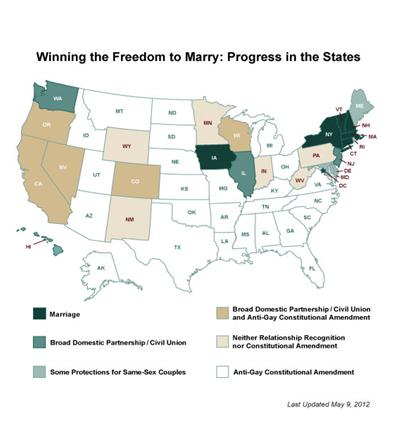
To date there are six states where gay marriage is legal. So far Connecticut, Iowa, Massachusetts, New Hampshire, Vermont and Washington D.C. have passed laws legalizing gay marriage. Delaware, Hawaii, Illinois, New Jersey and Rhode Island have civil unions and California, Oregon, Nevada and Washington offer domestic partnerships (Freedomtomarry.org). As we know, today, Maryland has on their ballot a proposition to legalize gay marriage. The sanctity of marriage is certainly under attack.

While the world around us is attacking the sanctity of marriage we can to look at Scripture to set our compass, I would like to submit to you several ideas that are presented through the Gospel.

First of all the concept of marriage has always been designed by God as a Covenant between one man and one woman. In the text we read this morning, we see that God created man and woman and that the man was to leave his family and to cleave to his wife. In the Hebrew language the term man is in the masculine tense and the term for woman is a female. Therefore, God’s design was always for marriage to be between a man and a woman. We also see that Paul in Ephesians 5:31 speaks to this as well when he states “Therefore a man shall leave his father and mother and hold fast to his wife, and the two shall become one flesh.”

The marriage between a man and woman is also a covenant as noted in Malachi 2:14 where Malachi stated But you say, “Why does he not?” Because the LORD was witness between you and the wife of your youth, to whom you have been faithless, though she is your companion and your wife by covenant.

It is interesting to note that that in the traditional Jewish wedding ceremony and the KETUBAH or the marriage contract the husband accepts certain marital responsibilities, such as the provision of food, shelter and clothing for his wife, and promises to care for her emotional needs as well. The contract is so important that the marriage is not complete until it signed by the groom and presented to the bride. This demonstrates that both husband and wife see marriage as more than a just a physical and emotional union, it is a moral and legal commitment. It is forbidden for Jewish couples to live together without this document. For the Jew, the marriage covenant symbolically represents the covenant between God and His people, Israel.

For Christians, marriage goes beyond the earthly covenant as well, as a divine picture of the relationship between Christ and his Bride, the Church. The marriage relationship models the work of God in us. The husband is to love his wife as Christ loved the church and gave himself for her. The wife in turn is to love her husband in recognition of his leadership and his commitment to Christ. So again we see that God’s view of marriage is to have one man and one woman united together in this covenant relationship.

A second issue that is seen through the Scripture is that misplaced emotions and ideologies cannot redefine marriage. One’s emotions and personal ideologies must never be the foundation of scriptural truth. When we depend on our emotions we can be easily deceived because our emotions can easily change.

Listen to what Paul says in Romans 1:19-32 For what can be known about God is plain to them, because God has shown it to them. For his invisible attributes, namely, his eternal power and divine nature, have been clearly perceived, ever since the creation of the world, in the things that have been made. So they are without excuse. For although they knew God, they did not honor him as God or give thanks to him, but they became futile in their thinking, and their foolish hearts were darkened. Claiming to be wise, they became fools, and exchanged the glory of the immortal God for images resembling mortal man and birds and animals and creeping things. Therefore God gave them up in the lusts of their hearts to impurity, to the dishonoring of their bodies among themselves, because they exchanged the truth about God for a lie and worshiped and served the creature rather than the Creator, who is blessed forever! Amen. For this reason God gave them up to dishonorable passions. For their women exchanged natural relations for those that are contrary to nature; and the men likewise gave up natural relations with women and were consumed with passion for one another, men committing shameless acts with men and receiving in themselves the due penalty for their error. And since they did not see fit to acknowledge God, God gave them up to a debased mind to do what ought not to be done. They were filled with all manner of unrighteousness, evil, covetousness, malice. They are full of envy, murder, strife, deceit, maliciousness. They are gossips, slanderers, haters of God, insolent, haughty, boastful, inventors of evil, disobedient to parents, foolish, faithless, heartless, ruthless. Though they know God’s decree that those who practice such things deserve to die, they not only do them but give approval to those who practice them.

It should be noted here that one sin is not greater than another. However, the problem is that some sins have greater consequences. God never intended for man to have a depraved mind but it is the response to rejecting the truth of Christ and His plan for life. So it is when we reject God’s plan and purpose for marriage.

The problem is that once again we see a slippery slope of degradation occurring as this relates to marriage. What began as people of the same sex wanting to have relationships has now evolved to them wanting all of the rights afforded married couples as defined by God. Unfortunately, it may not stop here. The organization LAMDA has reported that they are pushing for laws that will allow men to marry young boys and to have sex with them as a natural action of life.

And, finally moral depravity has always been at the center of the demise of every great nation or empire. Carl Zimmerman, a Harvard sociologist, in 1949 wrote a book entitled Family and Civilization. In the book he wrote, there are six major characteristics of any major world empire just before its fall.

  • Marriage is no longer viewed as a sacred institution and today we see the demise of the marriage union in this culture;
  • Alternative forms of marriage and family are condoned; gay marriage is being readily accepted as the norm;
  • There is a rise of feminist movements and the emasculation of males – it is interesting to note that the Bible has done more to liberate women than any other document. In Jesus’ time a man could divorce a woman for as little as burning the toast. Women were treated as a second class citizen but Jesus on many a occasion stated that man and woman were equal as a created being.
  • There is a breakdown of parental authority – Schools, computers, games and TV are now the greater substitute for parents.
  • Adultery is celebrated instead of recognized as a sin
  • There is a rise of sexual perversion including incest and homosexuality

As a nation we are on this slippery slope of our demise but we can make a difference. We can live according to God’s plan and purpose in regard to marriage. And, we need to know where the candidates stand on the sanctity of marriage. We can change and we can live out 2 Chronicles 7:14.

Where do the candidates stand? It is my belief that if our current administration remains in power that it will not be long before the church will be forced to support gay marriage or it will cease to exist as an institution. We see this in the recent developments with contraception and the Catholic Church. There is no regard for religious freedom and I believe that sanctity of marriage will be the next area that we see attacked. How do the candidates match up? Take a copy of the voter guide as you leave so you know where your candidate stands.

Leave a comment

Filed under Uncategorized

Moral Compass Part 2

Peninsula Community Church

October 21, 2012

Moral Compass for the Voting Booth

 Proverbs 3:5-6 Trust in the LORD with all your heart, and do not lean on your own understanding. In all your ways acknowledge him, and he will make straight your paths.

We are hearing much rhetoric about finances and the economic stability of our nation and our families which make up this nation today. We hear about the coming financial cliff if Washington does not respond or react to the issues facing America. We hear of looming tax hikes as a result of the enactment of the Health Care law. We hear of business owners who are closing their doors because they can no longer afford to run their businesses. We hear of business men afraid to hire any new employees because they do not know the future costs associated with running their business as a result of health care costs and new regulations that are being passed every day. We are hearing that Social Security and Medicare may be bankrupt as early as 2034 as reported by the current President’s own cabinet if nothing is done. Unemployment continues to be too high. The total number of people unemployed remains at 23 million people. More people are on food stamps and government programs than ever before. We can add to this the reduction in household income and the rise in prices of food, utilities and gas. And interestingly enough, no one republican or democrat is denying or disputing these claims.

While politicians and economists have much to say about finances, the Bible also has a lot to say and what the Bible says can help to realign our compass so that it is pointed to true North. The Bible serves as a guideline for our living as it is the truth that should guide our moral compass.

Let me share a couple of areas where I see the Bible speaking to our finances.

First of all the Bible calls us to an eternal perspective in regard to our finances. Jesus recognized this truth when He stated that “where you heart is there your treasure will be also” (Matthew 6:19-21). What He meant here is that we must recognize that we must be good stewards of what we possess but we will not take any of our possessions with us. Solomon said this about a man’s finances “He who loves money will not be satisfied with money, nor he who loves wealth with his income; this also is vanity. When goods increase, they increase who eat them, and what advantage has their owner but to see them with his eyes” (Ecclesiastes 5:10-11)?

But when we have an eternal perspective in regard to our finances we will master our finances but we will be sure and not allow our finances to master us. We will not borrow money we cannot pay back. We will not make investments that our children have to repay. We will recognize how blessed we are and how much God has given us. As a result we will strive to honor God with our finances so that the Kingdom is expanded and grown. Our goal and desire is to make deposits in our heavenly bank where moth, rust and corruption cannot harm them.
The perspective of many in political office is an eternal one but usually is a short term vision that is clouded by the desire to be reelected and to get money pouring into their particular district. But our success as a nation cannot be measured in who gets elected but how we steward the resources and the blessings we have as a nation.

Secondly, we have lost our dependency on God. In the early days of America, story after story has been written about how the settlers to this great nation had to trust almighty God to provide and keep them. But in the early 1900’s there was a shift away a dependency on God to a dependency on government to provide our every need. One of the problems experienced by Americans is that they have borrowed money to live the American dream. America as a nation is no different we either borrow more money or the feds print more money. The problem with borrowing money is that according to scripture we become a slave to the one who holds our debt. Currently, we are nearly 16 trillion in debt and China and Japan holds the largest percentage of that debt. The problem with borrowing money from someone is that the relationship changes rather quickly.
One of the unintended outcomes of our nations move toward welfare is that it has created an entitlement program where men and woman become dependent on its resources for their survival. The fact is this is an issue of trust. Who will we trust to provide our needs? Will we trust God “Who will supply all of my needs in Christ Jesus” or will I trust the government to be my provider. Too many today are trusting the government today as their source of provision.

Thirdly, we have a misguided understanding of who we should help. Helping others in need is an individual responsibility not the governments. In many ways the church has fallen short in its role of providing care. It is interesting to note that the Scriptures have a lot to say about helping others but the emphasis is almost always on the widow and the orphan. Nowhere does scripture justify giving assistance to one is able and capable to work. We have become a lazy and entitlement oriented nation. If you don’t work you don’t eat. In fact scripture says that if you don’t work you don’t eat. 2 Thessalonians 3:10 For even when we were with you, we would give you this command: If anyone is not willing to work, let him not eat.

Let’s look at who we have been called to help from a biblical standpoint. First of the church is called to help the widows and orphans. On several occasions the New Testament points to the need to be sure that the widow and orphan are being cared for. We see this when the disciples ordained deacons to care for the widows who felt that their needs were going unattended. Acts 6:1; James 1:27; and 1 Timothy 5 are examples of this. Beyond that the Bible speaks to families helping families as noted by Deuteronomy 15:7-11.

This does not rule out helping others but the focus of the help was to be on those who could not help themselves. In today’s environment there is no balance in this. I can remember when I first moved to NY I was involved in a refugee resettlement program through our church organization. It was interesting that those families that we settled into a home and a job had a remarkable success at being assimilated into the culture but for some who could not find jobs they were forced onto welfare and the result is that many of them never fully acclimated into their surroundings because they were now depend on the government to provide for

Let me say this I am offended by some who would use the Bible to justify giving money to those who do not deserve and have the ability to work for themselves.

And finally, we lack an attitude of contentment and thankfulness. We have been deceived into thinking that the way to satisfy our desires is to borrow more and more money to get what we don’t need for our immediate survival. We have a false idea that borrowing more money and spending more is the way to achieve greatness. The problem is that we borrow more so that we end up spending more not to reduce our debt but to feel secure.

This attitude is at the basis of the entitlement society in which we live. We feel we are entitled to a free education, free phones, free medical, free college and so on and so forth. But the fact is nothing is free it will cost someone something along the way. But we are reaching a point where more people are taking benefits than those who are paying into the system and when that happens we are in trouble.

I recently talked with someone who was in the Navy who related a story to me of a friend of theirs who had been late to work so many times that he staged getting beat up to avoid the consequences of another tardiness. But, if that is not the end of the story, that person is filing a claim for disability from the Navy because they have a provision that if you received a concussion while in the service you are entitled for this benefit. He staged a fight, stated at the hospital that he had passed out, the doctors diagnosed him with a concussion and now he is applying for disability.

To get back to the verse we used this morning when all is said and done who do you trust to provide for you. Do you trust God? Have you given yourself fully to Him? If not you can today. Just this week I was reading a book about evangelistic preaching and the author of the text make a great statement. He stated “The Good News is not just about getting saved but it is about living the saved life.” So how is your trust level? The fact is no matter who is elected this fall they will disappoint and fail us. But the government is not our savior. The government is not the answer to all of our woes only God can be that.

Leave a comment

Filed under Uncategorized

A Moral Compass to Guide You in The Voting Booth

Peninsula Community Church

Moral Compass To Live By – Unmovable Foundations

October 14, 2012

Text: Psalms 11:3 … if the foundations are destroyed, what can the righteous do?”

Psalms 89:14 Righteousness and justice are the foundation of your throne; steadfast love and faithfulness go before you.

1Corinthians 3:11 For no one can lay a foundation other than that which is laid, which is Jesus Christ.

As I was preparing for this message I remembered that in the mid 60’s and early 70’s I attended a church that taught the congregation that they should not buck the system and that religion and politics should not be mixed. The result was that prayer was taken from the schools; abortion became legal, and the origination of the current debate on the sanctity of marriage was begun all while many in the church remained silent and disengaged. But we can and should change that today.

I want to say to you that truth is only the moral compass that will lead us in the right direction. As believers, we must remember our faith and our sacred duty under that faith when we cast our vote in November. The separation of Church and State can never mean that the Church must remain silent on issues of faith and morals at the heart of government policy. Faithful citizens must not check their religion at the door to the voting booth. Your faith must be your guiding light and your moral compass as you cast your vote. Your vote gives you tremendous power. You have the ability to help preserve life, the family, and freedom. This is a tremendous power, and it comes with tremendous responsibility.

As we begin to take a look at the moral compass that should guide our decisions in the voting booth, I want to make a couple of comments. First of all the election of the right person into office is not going to change the face of America overnight. It will help chart a course for a better future but the election in itself is not the answer.

This brings me to my second observation and that is as believers we must do our part to make the gospel an integral part of how decisions are made. That means that we must allow the gospel to be the ruling authority over our lives again. It is only as believers allow the gospel to rule that we will see significant changes. This is in keeping with 2 Chronicles 7:14 where God calls His people to prayer, confession and repentance.

And this brings me to my third observation. When we begin to discuss the issue of politics I recognize that in a setting like this that there is no doubt a divergence of views and ideas about who should be elected and why. I am sure that if we polled this group in a way where everyone’s response would be kept private that we would indeed have varying views and sometimes about the same person or ideology.

In the first passage we read, David speaks to an issue that is prevalent in every generation but it seems to be more pronounced in some generations than other. It is my belief that we are living in such a time where the very foundations of our society and culture have lost their moorings and need to be realigned with God’s design and purpose.

It is a tragic thing for the foundation of a building to begin to crumple because it will not be too far down the road that the building on which it is built will begin to feel the impact of that crumbling foundation.

In Psalm 89:14 David reminds us that the foundation of God’s throne is righteousness and justice. When these two characteristics are diminished we are in for changes that will effect generations to come.

We will also note that Psalms 11 begins with the premise that we must trust in God and once we lose trust in a Sovereign, creating and loving God we have begun a spiral away from God’s intentions and therefore our foundations will be shaken.

You might ask how the foundation of America is being impacted. I propose the following:

  • Tolerance VS intolerance – we must accept everyone’s sin and belief system with judgment but too often those that want us to be tolerant of them are not very tolerant of us.
  • Religious pluralism – today every religious belief has equal footing and there is the belief that all religions help us arrive at a new state of consciousness or gets us to heaven but we know as believers that there is only one way to heaven and that is through Christ.
  • Privatizing of religion – there is a move afoot to privatize religion. You can be religious but do so on your own time. There is a separation of the sacred and the secular but the fact is we never stop being a Christian.
  • Shift of morals to values – today we one’s perspective as being more valuable than one’s moral footing. Morals never change while what one values change from day to day and from situation to situation.
  • Entitlement mindset VS work ethic – at one time America’s strength was its work ethic. Men settled the west and farmed the land but today we have a mindset that we are entitled something for nothing.

 Through scripture we know that it is God that established governments to protect and lead in righteousness but governments can err and compromise its moral integrity (Romans 13) but we also know that we can affect the future and change the course of our nation by exercising the right and privilege we have to vote.

  • Vote our conscience
  • Vote intelligently
  • Vote Biblically
  • Vote Prayerfully


Leave a comment

Filed under Uncategorized